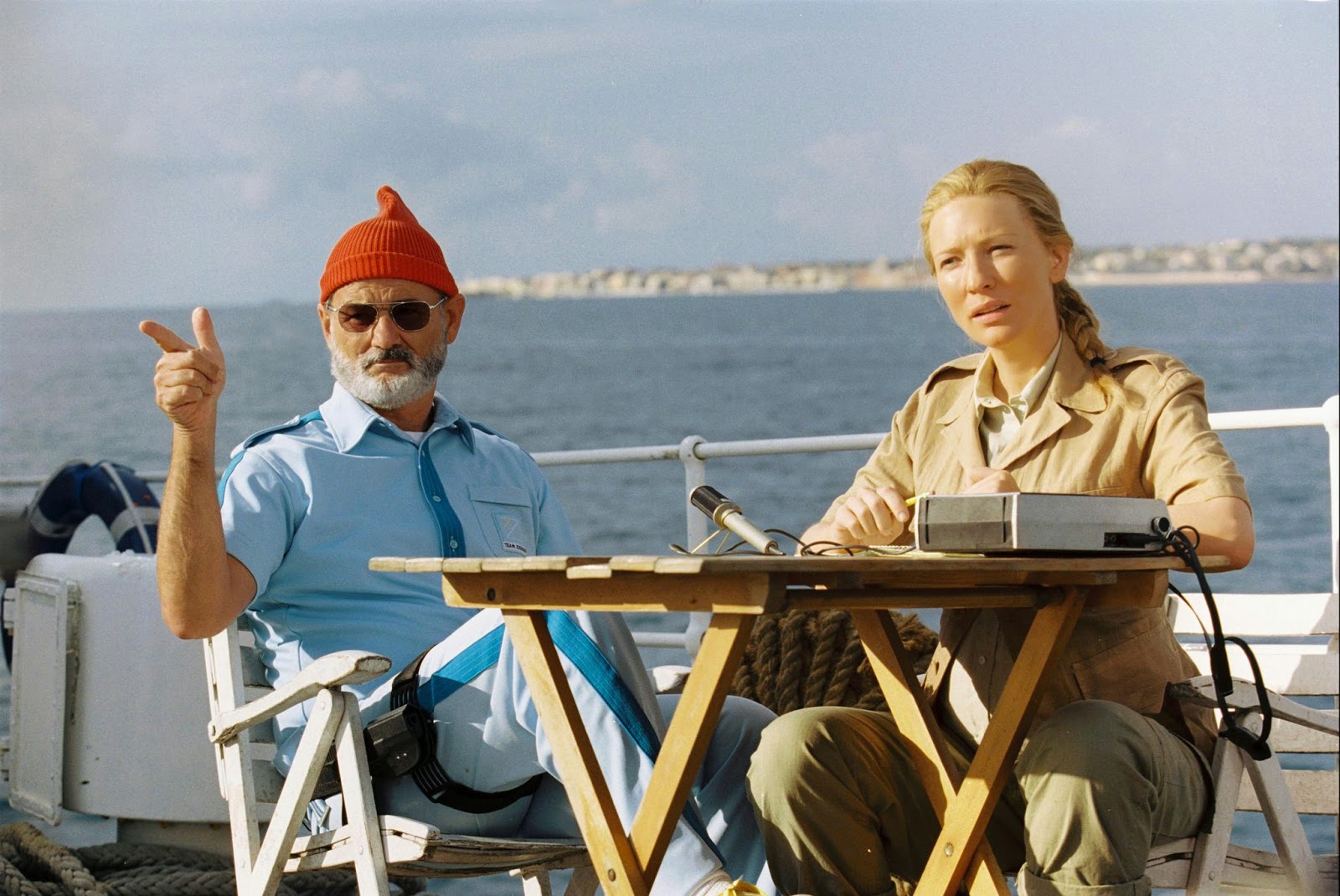
Every now and then at Screen Vistas I like to team up with Max O’Connell over at The Film Temple to tackle the work of one of our favorite directors. This time we’re looking at comedy stylist/master of whimsy Wes Anderson.
 Loren Greenblatt: Wes Anderson’s fifth film is a bit of an odd duck. It’s actually two films, a short film and then a full feature which he made later. The short, Hotel Chevalier finds Jason Schwartzman, for the first time in an Anderson film since Rushmore, pulling a geographic. He’s a perturbed man who’s run away from his problems in a French hotel. He learns that an old flame played by Natalie Portman has tracked him down and is coming to see him. There’s a nice little stretch where he sets about making the room up, sprucing himself up, finding exactly which song he’s going to play (“Where to You Go To My Lovely by Peter Sarstedt) in anticipation of what he hopes will be a romantic event.
Max O'Connell: Yeah. It’s pretty extraordinary that we don’t know the full details of their relationship, but we can tell by the intonation in Schwartzman’s voice and in his body language that this is someone very important to him who’s hurt him. He’s trying to do whatever he can to get things in order and keep his life together, but when we see him for the first time, he’s retreated from the world. He’s in this nice warm place where everything is bright yellow, and he’s wearing a bright yellow robe. He’s watching Stalag 17 on TV. And when she calls, that shield from the rest of the world comes tumbling down. It becomes the kind of melancholy we’ve seen from Anderson before, but much older and deeper.
LG: There’s this really nice moment where they open the door, and they come into an embrace. Schwartzman goes in for the kiss, but Portman goes for his shoulder, immediately drawing of the lines of how they feel. They don’t really dwell on this moment, so it’s one of those quick little things. It is an older melancholy, and less whimsical film than we’ve seen from Anderson. The film is sort of about that song. A lot of the film takes place with the song playing seemingly in its entirety under the dialogue. The song is about this man who’s pining for a lost woman, and he knows all these great details about her but can’t quite get inside her head. The film is almost a music video, or as close as Wes Anderson has ever gotten.
 MO: In part because it is so much shorter, and it does feature the song very heavily. So much of it is so wonderfully choreographed to that song, particularly near the end after they’ve decided to have sex, and you can tell they have a lot of feelings for each other, but it’s leftover affection for something that’s clearly not working and has not worked out. We don’t know the full details of her character – she has bruises, but he’s surprised to see them, and they haven’t been together for a while – so it’s a kind of thing that she’s equally damaged if more enigmatic. The way Anderson frames them, for the most part, it’s in a long shot to imply the emotional distance between the two or a tight close up. I love the intimacy when they finally embrace, start kissing, and he starts undressing her. They’re so close together, but so far apart because they know this is the end of it, because he doesn’t want to see her again after this.
LG: Yeah, and he’ll double back on this in the feature film, but it’s not looking great. She tries to repair their friendship, but he’s not going for it. He flat-out says that he doesn’t care she didn’t mean to hurt him, that he never wants to be her friend, and that he’s OK with her feeling like shit if they fuck. There’s a sense of finality at this point.
MO: And of bitterness. It’s not self-pity, necessarily, but it’s something we could understand. It’s a wallop of a short, and it ends beautifully. It’s so confident that a lot of people felt that the feature paled a bit in comparison.
LG: To some degree, I think that. We should talk about how this connects to The Darjeeling Limited. Wes Anderson at the time was wishy-washy on whether or not he wanted this to be a part of the film or not. He shot it earlier, didn’t have a script for Darjeeling so much as an outline. Initially it was not attached to the film theatrically. On limited release, it was left out and released on iTunes. On wide release, it was attached.
MO: Which is how I saw it.
LG: So there’s a question of whether or not it’s part of the film. It’s billed as “Part I of The Darjeeling Limited” in the credits, but how should it be consumed? It’s still not definitively answered. For this rewatch, I saw Darjeeling first to try to take them as separate films. I could definitely understand seeing them together, but they’re also separated by style. Hotel is very much a summation of the Wes Anderson style to this point, where Darjeeling departs from it in very important ways.
MO: Yes it does!

LG: The opening of Darjeeling is done in media res, which is unusual for Anderson, who’s given to gentler, storybook introductions. We open on an unnamed businessman played by Bill Murray trying to make a train in India. The cab is rushing, there a lot of chaotic whip pans and handheld shots. Murray makes it to the station as the train is pulling out, and he chases after it. We get this gorgeous slow motion tracking shot set to The Kinks’ “This Time Tomorrow.” And there’s a much younger man, Peter (Adrien Brody), who overtakes him and makes the train as he’s left behind. I don’t see the film as one of his best, but the opening is so masterful and full of subtext and symbolism that I wonder why the rest falls so short for me and a lot of people.
MO: It’s an interesting question, though I’d like to double back a bit. You said it’s not totally resolved on how that short connects to the film. We’re split on this. You’re torn, I think as soon as he did end up continuing the story (the short’s events are mentioned in the film, and Schwartzman’s character is one of the film’s protagonists alongside Brody and Owen Wilson). For me it’s a definitive part of the film. The difference in style is important because Darjeeling was at a point where people started knocking Anderson not stepping outside of his aesthetic (which is a stupid criticism, but whatever). Hotel Chevalier sees him doubling down on that style for a character who’s receding into it. The feature is still recognizably Anderson, but it is a bit of a departure (ironically, people still complained that it was too Wes-y), because it’s about trying to get into something new. The in media res opening, which I see as a whimsical homage to The French Connection, is about trying to break away from that. It’s very purposeful.
LG: It’s not that Anderson has completely left whimsy and storybook trappings aside. That opening is very storybook but in a different way, but it’s not as booklike. This is the first film he’s done since Bottle Rocket without some sort of chapter heading or curtain raise at the start of every new section. His bright color pallet is still there, but he utilizes shallow focus and long lenses to much greater extent and he moves the camera in new ways. He’s very much taking for a new set of influences. He acknowledges Satyajit Ray and Jean Renoir’s film The River. There is a sense of stylistic exploration. I just wish it happened to more interesting characters.
 MO: We’re going to disagree about how interesting they are, but let’s get into the style. It’s interesting how he’s sort of trying to have a lighter touch and mix the poetic realism of Renoir and Ray with his usual aesthetic. It’s still very colorful, and he does something with music that he had only hinted at before. Michael Powell had a theory of the “composed film,” where every element, from the designs to the actors to the music moving together and going together in a sort of synchronicity. Anderson played with that in the past, but it’s a lot more obvious here, particularly whenever he choreographs characters to music in slow motion to the Kinks with “Strangers” or “This Time Tomorrow” or “Powerman,” and I also think of the use of an underrated Stones song, “Play with Fire.” He’s choreographing to music pretty much the entire time, even if it’s just background music of Satyajit Ray’s films.
LG: His use of music has always been strong, but he does use it a little differently here. He let’s a lot of the pieces, particularly the non-English ones, play more atmospherically than in the past.
MO: Like the use of the Debussy piece when they’re around the fire.
LG: Or the stuff on the trains. It’s a huge stylistic choice, but it’s allowed to be more in the background than in the past. There’s a confidence to that.
MO: Something else that’s interesting: on the train, he’s using anamorphic framing for much tighter spaces. No matter how they try, these characters can’t really get away from each other. It’s a nice metaphor for how the family binds them together.
 LG: We should actually talk about the plot. Jack (Schwartzman), Peter (Brody), and Francis (Wilson) are brothers, with Francis as a bit of an older, more damaged version of Wilson’s Bottle Rocket character, Dignan. These guys have been estranged for some time, and Francis has made a plan to get them back together in India, and they’re going on a spiritual journey because that’s what White people think you do in India. Francis has this very planned out with lists and itineraries, which are all laminated, and has a secret plan to bring his brothers to this place where their estranged mother (Anjelica Huston) is working as a missionary. But I don’t think these characters are as interesting. They have nice moments: I like that immediately as they arrive on the train, they bond by comparing the various illegal painkillers they’re on. But I thought a lot about The Royal Tenenbaums, which also has an estranged family trying to figure out if they want to be a family again. That film showed us what forced this fissure. Here, Anderson and his co-screenwriters Jason Schwartzman and Roman Coppola skip over that for the sake of narrative efficiency, but they end up doubling back, and a lot of the first half of the film feels like exposition to me in a very irritating way.
MO: You’re going to have to elaborate on that, because I don’t understand that criticism at all.
LG: There are all these running gags that inform us how they related to each other over the years. There’s a scene where one brother confesses a secret to a brother and asks for secrecy, and he’s immediately ratted out to the third brother. They do this seemingly endlessly and it got old for me pretty quick. Their bickering becomes more trying than interesting. These characters become more poignant by the end with the help of some really good filmmaking, but I think it’s the thinnest script he’s ever done and don’t find any of them compelling in the first half.
MO: They are to me. Part of it is me seeing them as all being connected to previous Wes Anderson characters with the wind knocked out of them by life: you mentioned Francis as being connected to Dignan, I see Jack as a sadder, more mature Max Fischer who’s retreated from the world –
LG: But Max Fischer has passions and interests. I don’t think Jack is that into being a writer. I think Owen Wilson has some sort of an education job, but it’s not explicitly mentioned…I don’t know who these people are outside of bickering.
MO: Huh. You don’t think Schwartzman is into writing? I don’t get that.
LG: He’s a writer who’s fallen back to just transcribing his life. That’s actually one of the gags I like. Every time he shares a story with his brothers, they’ll comment on how they like how they like that their characters did this or that, and Schwartzman will insist that the characters are all fictional.
MO: It’s not about falling back. It’s about how our art, however much we insist it doesn’t, reflects what we’re going through and who we are. Wes Anderson is a very private person, so we don’t know all the details, but so much of it is his addressing that his work reflects the struggles he’s gone through. And I do see him as being his into his writing. It’s his way of processing his grief, his melancholy, his problems, which is how many of us channel and understand our problems. He’s not admitting what he’s doing, though, so it doesn’t allow him to heal until later in the film.
LG: Part of it is that he’s such a depressed character in the short. The first image we get of him is him sitting in a bed, not moving much. All of these guys are on intense sedatives, so maybe that’s where I got that he isn’t into his work as much. And there’s also a sense in all of Anderson’s films after Rushmore that these characters wonder if they’re past their prime.
MO: Yeah. And I do see a bit of that in here, but that still connects him to Max Fischer to me in a really interesting way. Brody, meanwhile, hadn’t worked with Anderson before, but I see a lot of Margot and Chas Tenenbaum here, both in his secrecy and his prickliness. Where Schwartzman is mopey and Wilson’s trying to force the whimsy and spirituality (I love his insisting that everything around him is beautiful or incredible as a way to convince everyone, which will never work), Brody is the one who will lash out.
LG: But the thing is that you can describe the interplay between his characters in other films, but it also feels like a new thing. In Life Aquatic, the character relationships are among the most well thought out in the Anderson canon. I’ve always kind of felt that this was written more on the fly, a bit scrappier and ramshackle. He didn’t know what he wanted, but he wanted it in India, on a train and with these people. I think these are his flattest set of characters since Bottle Rocket.
MO: Hmm. I’d agree that they’re a bit more sketched out, and that is why this is probably his weakest film, but I view them more collectively than individually. Their relationship is the main character. It’s less about one of them and more about how they’re essentially symbiotic, whether they want to be or not. I also find the bickering funnier, and admittedly connect more to the characters than you do.
LG: You actually have siblings, I don’t.
MO: That could be part of it. And because it’s about a real family, it’s going to be at least partially in Tenenbaums’s shadow, and I think that’s why so many people are down on Darjeeling. I appreciate that we don’t get the full backstory, we just have to pick up from the way they act around each other what happened to them in the past. We get a bit about their mother’s distance, or about their father possibly having a favorite, without seeing it in a flashback or something. They’re so affected by how their parents have raised them, as with his previous film, but I appreciate that this film trusts us to pick up the cues.
LG: In theory, I agree with you. On paper, I understand that in terms of efficiency. But I don’t think it works with these particular characters, Though there are more moments of life as the film goes on like a wonderful reminder for how Anderson works with dialogue where Francis describes their mother: “She’s been disappearing all our lives.” That’s a wonderful line. When we meet her at the end of the film, that’s a fantastic moment. But there’s this shift midway after they leave the train and we’re meant to empathize with them more and it doesn't work 100% for me. They try to save three kids who fall into a river, and one of them dies. It becomes this sort of literary metaphor where the funeral for the Indian boy stands in for their father’s funeral, which they missed, and there's a greater metaphor where this exotic new land stands in for the alienation they feel living in a new world without their father. Which isn't completely invalid (Lost In Translation does something similar), but it's also a bit problematic seeing an entire country, and in this case a dead child, used to stand in for a dead white man. None of this is outrageously underlined in the film and it's not as big a problem as it could be but there’s a few people who point to Anderson’s treatment of race and point to this film as crossing a line and using Indian people as props and while I don't think it's as cut and dry as that, it's hardly invalid either.
 MO: I do think that criticism is more merited here than in the past. Part of it is about these guys being ugly Americans abroad and not appreciating what’s around them, not being respectful of or interested in the culture except as a form of exoticism (which is something a lot of people knocked without realizing that the film is being autocritical). And they are more than props. I like the two major Indian characters on the train: The Chief Steward (Waris Ahluwalia), who’s furious with the brothers for their reckless behavior, and Rita (Amara Karan), who’s treated similarly to Inez in Bottle Rocket but more successfully.
LG: Because they can understand each other. Schwartzman goes after her because she’s hot and Indian, but back in reality, she’s clearly got some shit going on, and is in a complicated relationship with the train’s head steward that may or may not be on the rocks. That’s a very humanizing moment, but I wish we saw more of that character. She’s the one who reminds me of Margot Tenenbaum, not Adrien Brody. I really wish she could have shown up near the end. I could have seen a movie about her.
MO: But that’s not what the movie is about. It’s about these guys getting perspective. By the time they part, he realizes that she’s just as filled with life (and just as messed up) as he is, and that she’s not just some exotic object to be obtained.
LG: Then there's the way he shoots India. This is the most location based film he’s worked on at this point, there are still artificial sets, but less than in his previous few films, I do get the sense that he’s trying to portray India as a place that exists in reality rather than sticking purely to his normal fantasy diorama mode. But at the same time, I think he’s trying to have it both ways with how he portrays this foreign culture.
MO: That’s fair. I think she’s handled well, as is the head steward. His reactions are funny, he’s the straight man to these out-of-control characters, but he’s also the most reasonable person in the film. The only point where the film does have some problems for me is the death of the Indian boy, which is used as a way to bring them together and realize the importance of family. It ties into the film’s tendency to rely on big, literary symbols, like their fathers’ baggage that they cart around standing in for the baggage they carried over from their parents, or the physical scars Francis bears on his head from a motorcycle crash standing in for his emotional scars. It’s a bit much, and the boy’s funeral is an extension on that with the added problem of accidentally trivializing his death to bring them together and call back to their father’s funeral. It’s trying to be humane, it’s just a bit off in execution.
LG: The thing I wondered about probably around halfway through the film is, considering that this film is much more somber than most of Anderson’s work, is whether this film is meant to be a comedy or Anderson’s first drama that just happens to have comedic moments?
MO: That’s a good question. It’s certainly more somber than his previous work, it’s tipping towards drama, but there’s too much of Anderson who’s a comedic stylist to cancel that out. It’s closer to a pure drama than anything he’s ever made.
LG: I do feel that even though the film is indulgent in a lot of ways, he is trying to break out of his Wes Andersonisms, even though in doing so a lot of people think this is the most Andersonian thing.
MO: People who made the criticism that it was schtick rather than an aesthetic, which, no. It has different drawbacks, though I don’t think they’re as problematic as you do. Now, do you think it does gain cumulative power by the end? It might be a more personal thing for me, since I do have siblings and I do view them collectively rather than separately.
LG: Absolutely I do. There’s a lot of stuff that works, but I also found myself wondering whether it would be more powerful if it happened to the Tenenbaums or the Belafonte crew. Their dimensionality gets added in, but it doesn't totally make up for how much I was twiddling my thumbs in the first twenty minutes. But it does have some of his most masterful moments of filmmaking. We mentioned the opening, but there’s also a great flashback to them almost missing their father’s funeral (set within one of Schwartzman’s “fictional” stories). And when they finally meet their mother, Huston shows up in another wonderful role. I love these two together almost as much as I love him with Bill Murray. There’s a line where she suggests that they can have a connection better without words, if they say everything with glances. It’s a little cloying, but then it goes into one of Anderson’s most interesting sequences, set to “Play With Fire,” where there’s a tracking shot through all of these little vignettes between these different characters they’ve encountered, and it’s all shot as if they’re connected on a train, but it’s looking into their houses, their airplanes, their bedrooms. It pans off of it to this tiger in the jungle, a bit of an overt symbol, but very powerful when combined with the music. That got me. That always gets me.
 MO: Here’s the interesting thing about Huston’s character: it’s a smaller role than we’ve seen from her in past collaborations with Anderson, and it’s a different role. In the past, she was a warm and giving mother figure or at very least the person who maintained a sense of order amidst the chaos. Here, she’s removed from them. She’s had the same effect on them that Royal had on his kids. She was absent at their funeral, but when we first meet her, her behavior echoes that of her sons. She’s very controlling about what they’re going to eat and do, like Wilson, but she also insults the flower pot that Brody’s wife made, which is interesting because it’s the kind of behavior that Brody does. And she’s retreated from the world, much like Schwartzman. That’s how much he’s reacted, he’s tried to get away from them just like she did.
LG: And up to this point, the questionable parent in Anderson’s films has usually been the father. Here, they lionize their father and have an issue with their mother.
MO: There’s a bit of an elephant in the room when it comes to this film regarding Owen Wilson. The same year this was released, Wilson attempted suicide after a relationship broke up. In the film, he claims to not remember the details regarding his motorcycle accident that smashed up his face and body, but we later learn it was intentional.
LG: I think it might have had a tougher overtone had he co-written the film, but it’s hard to watch without that extratextual knowledge. Obviously it wasn’t intentional.
MO: Which is also why the blatant symbol of Wilson removing his bandages and seeing that, in their words, he still has “some more healing to do,” is groan-worthy on one end but still very moving. I’m still shaken by how affected he is by everything he’s been through.
LG: Anderson and Coppola have worked together since, but Coppola also directed a little movie called CQ, which has an amazing score by Mellow but the film is just okay and clearly a Wes Anderson wannabe. It features a prickly artsy-fartsy guy editing a sci-fi movie who has daddy issues and want’s to assert his creativity in a meaningful way. They have the same cinematographer, Robert Yeoman. It’s interesting to see Anderson take in an imitator. Anderson wrote Darjeeling with Schwartzman and Coppola, which is interesting because both Schwartzman and Coppola are part of the Coppola family, with one as the son of Francis and brother of Sofia, the other as the son of Francis’s sister Talia Shire. It’s almost like Anderson is a lost Coppola cousin, considering the subjects he takes on.
MO: I hadn’t considered that, but it’s an interesting thought, considering that two members of a big, famous family are writing about family. It’s also worth considering that so much of this is about the possibility of losing a sibling, and Roman Coppola’s brother Giancarlo died in a boating accident in the late 80s.
LG: When there’s three screenwriters, we don’t know who’s responsible for what, and I don’t want to theorize too much.
MO: Me neither, but it’s an interesting parallel, and as I said, your art inevitably reflects your life to some degree. And that Schwartzman’s character acknowledges that by the end, that’s interesting to me. And I love the final gesture: Wilson, the controlling brother, tries to give back the passports he took from his siblings, and they trust him to keep them.
LG: That got me. That’s one part that got me that made me feel that it had to be those characters, and I wish they were just more interesting before that point. Also, there’s a very powerful snapshot as they let their baggage fall away.
MO: A shot that’s so well handled and set beautifully to “Powerman,” but it still kind of bugs me for the over-the-top symbolism.
LG: Maybe. But that final moment does tie back to their bickering well, yeah. I do think this is his weakest film, but there’s a lot of interesting stuff even if it’s minor.
GRADES (SHORT/FEATURE)
LOREN: A-/B-
MAX: A-/B+
That concludes our discussion of Hotel Chevalier and The Darjeeling Limited, if you agreed or disagreed, feel free to leave a comment below. You can also follow Screen Vistas on Facebook by clicking here.
Roundtable Directory:
Bottle Rocket (short and feature)
Rushmore
The Royal Tenenbaums
The Life Aquatic with Steve Zissiou
Hotel Chevalier / Darjeeling Limited
The Fantastic Mr. Fox
Moonrise Kingdom
Shorts and Commercials
The Grand Budapest Hotel
Max O'Connell: Yeah. It’s pretty extraordinary that we don’t know the full details of their relationship, but we can tell by the intonation in Schwartzman’s voice and in his body language that this is someone very important to him who’s hurt him. He’s trying to do whatever he can to get things in order and keep his life together, but when we see him for the first time, he’s retreated from the world. He’s in this nice warm place where everything is bright yellow, and he’s wearing a bright yellow robe. He’s watching Stalag 17 on TV. And when she calls, that shield from the rest of the world comes tumbling down. It becomes the kind of melancholy we’ve seen from Anderson before, but much older and deeper.
LG: There’s this really nice moment where they open the door, and they come into an embrace. Schwartzman goes in for the kiss, but Portman goes for his shoulder, immediately drawing of the lines of how they feel. They don’t really dwell on this moment, so it’s one of those quick little things. It is an older melancholy, and less whimsical film than we’ve seen from Anderson. The film is sort of about that song. A lot of the film takes place with the song playing seemingly in its entirety under the dialogue. The song is about this man who’s pining for a lost woman, and he knows all these great details about her but can’t quite get inside her head. The film is almost a music video, or as close as Wes Anderson has ever gotten.
LG: Yeah, and he’ll double back on this in the feature film, but it’s not looking great. She tries to repair their friendship, but he’s not going for it. He flat-out says that he doesn’t care she didn’t mean to hurt him, that he never wants to be her friend, and that he’s OK with her feeling like shit if they fuck. There’s a sense of finality at this point.
MO: And of bitterness. It’s not self-pity, necessarily, but it’s something we could understand. It’s a wallop of a short, and it ends beautifully. It’s so confident that a lot of people felt that the feature paled a bit in comparison.
LG: To some degree, I think that. We should talk about how this connects to The Darjeeling Limited. Wes Anderson at the time was wishy-washy on whether or not he wanted this to be a part of the film or not. He shot it earlier, didn’t have a script for Darjeeling so much as an outline. Initially it was not attached to the film theatrically. On limited release, it was left out and released on iTunes. On wide release, it was attached.
MO: Which is how I saw it.
LG: So there’s a question of whether or not it’s part of the film. It’s billed as “Part I of The Darjeeling Limited” in the credits, but how should it be consumed? It’s still not definitively answered. For this rewatch, I saw Darjeeling first to try to take them as separate films. I could definitely understand seeing them together, but they’re also separated by style. Hotel is very much a summation of the Wes Anderson style to this point, where Darjeeling departs from it in very important ways.
MO: Yes it does!
LG: The opening of Darjeeling is done in media res, which is unusual for Anderson, who’s given to gentler, storybook introductions. We open on an unnamed businessman played by Bill Murray trying to make a train in India. The cab is rushing, there a lot of chaotic whip pans and handheld shots. Murray makes it to the station as the train is pulling out, and he chases after it. We get this gorgeous slow motion tracking shot set to The Kinks’ “This Time Tomorrow.” And there’s a much younger man, Peter (Adrien Brody), who overtakes him and makes the train as he’s left behind. I don’t see the film as one of his best, but the opening is so masterful and full of subtext and symbolism that I wonder why the rest falls so short for me and a lot of people.
MO: It’s an interesting question, though I’d like to double back a bit. You said it’s not totally resolved on how that short connects to the film. We’re split on this. You’re torn, I think as soon as he did end up continuing the story (the short’s events are mentioned in the film, and Schwartzman’s character is one of the film’s protagonists alongside Brody and Owen Wilson). For me it’s a definitive part of the film. The difference in style is important because Darjeeling was at a point where people started knocking Anderson not stepping outside of his aesthetic (which is a stupid criticism, but whatever). Hotel Chevalier sees him doubling down on that style for a character who’s receding into it. The feature is still recognizably Anderson, but it is a bit of a departure (ironically, people still complained that it was too Wes-y), because it’s about trying to get into something new. The in media res opening, which I see as a whimsical homage to The French Connection, is about trying to break away from that. It’s very purposeful.
LG: It’s not that Anderson has completely left whimsy and storybook trappings aside. That opening is very storybook but in a different way, but it’s not as booklike. This is the first film he’s done since Bottle Rocket without some sort of chapter heading or curtain raise at the start of every new section. His bright color pallet is still there, but he utilizes shallow focus and long lenses to much greater extent and he moves the camera in new ways. He’s very much taking for a new set of influences. He acknowledges Satyajit Ray and Jean Renoir’s film The River. There is a sense of stylistic exploration. I just wish it happened to more interesting characters.
MO: We’re going to disagree about how interesting they are, but let’s get into the style. It’s interesting how he’s sort of trying to have a lighter touch and mix the poetic realism of Renoir and Ray with his usual aesthetic. It’s still very colorful, and he does something with music that he had only hinted at before. Michael Powell had a theory of the “composed film,” where every element, from the designs to the actors to the music moving together and going together in a sort of synchronicity. Anderson played with that in the past, but it’s a lot more obvious here, particularly whenever he choreographs characters to music in slow motion to the Kinks with “Strangers” or “This Time Tomorrow” or “Powerman,” and I also think of the use of an underrated Stones song, “Play with Fire.” He’s choreographing to music pretty much the entire time, even if it’s just background music of Satyajit Ray’s films.LG: His use of music has always been strong, but he does use it a little differently here. He let’s a lot of the pieces, particularly the non-English ones, play more atmospherically than in the past.
MO: Like the use of the Debussy piece when they’re around the fire.
LG: Or the stuff on the trains. It’s a huge stylistic choice, but it’s allowed to be more in the background than in the past. There’s a confidence to that.
MO: Something else that’s interesting: on the train, he’s using anamorphic framing for much tighter spaces. No matter how they try, these characters can’t really get away from each other. It’s a nice metaphor for how the family binds them together.
LG: We should actually talk about the plot. Jack (Schwartzman), Peter (Brody), and Francis (Wilson) are brothers, with Francis as a bit of an older, more damaged version of Wilson’s Bottle Rocket character, Dignan. These guys have been estranged for some time, and Francis has made a plan to get them back together in India, and they’re going on a spiritual journey because that’s what White people think you do in India. Francis has this very planned out with lists and itineraries, which are all laminated, and has a secret plan to bring his brothers to this place where their estranged mother (Anjelica Huston) is working as a missionary. But I don’t think these characters are as interesting. They have nice moments: I like that immediately as they arrive on the train, they bond by comparing the various illegal painkillers they’re on. But I thought a lot about The Royal Tenenbaums, which also has an estranged family trying to figure out if they want to be a family again. That film showed us what forced this fissure. Here, Anderson and his co-screenwriters Jason Schwartzman and Roman Coppola skip over that for the sake of narrative efficiency, but they end up doubling back, and a lot of the first half of the film feels like exposition to me in a very irritating way.MO: You’re going to have to elaborate on that, because I don’t understand that criticism at all.
LG: There are all these running gags that inform us how they related to each other over the years. There’s a scene where one brother confesses a secret to a brother and asks for secrecy, and he’s immediately ratted out to the third brother. They do this seemingly endlessly and it got old for me pretty quick. Their bickering becomes more trying than interesting. These characters become more poignant by the end with the help of some really good filmmaking, but I think it’s the thinnest script he’s ever done and don’t find any of them compelling in the first half.
MO: They are to me. Part of it is me seeing them as all being connected to previous Wes Anderson characters with the wind knocked out of them by life: you mentioned Francis as being connected to Dignan, I see Jack as a sadder, more mature Max Fischer who’s retreated from the world –
LG: But Max Fischer has passions and interests. I don’t think Jack is that into being a writer. I think Owen Wilson has some sort of an education job, but it’s not explicitly mentioned…I don’t know who these people are outside of bickering.
MO: Huh. You don’t think Schwartzman is into writing? I don’t get that.
LG: He’s a writer who’s fallen back to just transcribing his life. That’s actually one of the gags I like. Every time he shares a story with his brothers, they’ll comment on how they like how they like that their characters did this or that, and Schwartzman will insist that the characters are all fictional.
MO: It’s not about falling back. It’s about how our art, however much we insist it doesn’t, reflects what we’re going through and who we are. Wes Anderson is a very private person, so we don’t know all the details, but so much of it is his addressing that his work reflects the struggles he’s gone through. And I do see him as being his into his writing. It’s his way of processing his grief, his melancholy, his problems, which is how many of us channel and understand our problems. He’s not admitting what he’s doing, though, so it doesn’t allow him to heal until later in the film.
LG: Part of it is that he’s such a depressed character in the short. The first image we get of him is him sitting in a bed, not moving much. All of these guys are on intense sedatives, so maybe that’s where I got that he isn’t into his work as much. And there’s also a sense in all of Anderson’s films after Rushmore that these characters wonder if they’re past their prime.
MO: Yeah. And I do see a bit of that in here, but that still connects him to Max Fischer to me in a really interesting way. Brody, meanwhile, hadn’t worked with Anderson before, but I see a lot of Margot and Chas Tenenbaum here, both in his secrecy and his prickliness. Where Schwartzman is mopey and Wilson’s trying to force the whimsy and spirituality (I love his insisting that everything around him is beautiful or incredible as a way to convince everyone, which will never work), Brody is the one who will lash out.
LG: But the thing is that you can describe the interplay between his characters in other films, but it also feels like a new thing. In Life Aquatic, the character relationships are among the most well thought out in the Anderson canon. I’ve always kind of felt that this was written more on the fly, a bit scrappier and ramshackle. He didn’t know what he wanted, but he wanted it in India, on a train and with these people. I think these are his flattest set of characters since Bottle Rocket.
MO: Hmm. I’d agree that they’re a bit more sketched out, and that is why this is probably his weakest film, but I view them more collectively than individually. Their relationship is the main character. It’s less about one of them and more about how they’re essentially symbiotic, whether they want to be or not. I also find the bickering funnier, and admittedly connect more to the characters than you do.
LG: You actually have siblings, I don’t.
MO: That could be part of it. And because it’s about a real family, it’s going to be at least partially in Tenenbaums’s shadow, and I think that’s why so many people are down on Darjeeling. I appreciate that we don’t get the full backstory, we just have to pick up from the way they act around each other what happened to them in the past. We get a bit about their mother’s distance, or about their father possibly having a favorite, without seeing it in a flashback or something. They’re so affected by how their parents have raised them, as with his previous film, but I appreciate that this film trusts us to pick up the cues.
LG: In theory, I agree with you. On paper, I understand that in terms of efficiency. But I don’t think it works with these particular characters, Though there are more moments of life as the film goes on like a wonderful reminder for how Anderson works with dialogue where Francis describes their mother: “She’s been disappearing all our lives.” That’s a wonderful line. When we meet her at the end of the film, that’s a fantastic moment. But there’s this shift midway after they leave the train and we’re meant to empathize with them more and it doesn't work 100% for me. They try to save three kids who fall into a river, and one of them dies. It becomes this sort of literary metaphor where the funeral for the Indian boy stands in for their father’s funeral, which they missed, and there's a greater metaphor where this exotic new land stands in for the alienation they feel living in a new world without their father. Which isn't completely invalid (Lost In Translation does something similar), but it's also a bit problematic seeing an entire country, and in this case a dead child, used to stand in for a dead white man. None of this is outrageously underlined in the film and it's not as big a problem as it could be but there’s a few people who point to Anderson’s treatment of race and point to this film as crossing a line and using Indian people as props and while I don't think it's as cut and dry as that, it's hardly invalid either.
LG: Because they can understand each other. Schwartzman goes after her because she’s hot and Indian, but back in reality, she’s clearly got some shit going on, and is in a complicated relationship with the train’s head steward that may or may not be on the rocks. That’s a very humanizing moment, but I wish we saw more of that character. She’s the one who reminds me of Margot Tenenbaum, not Adrien Brody. I really wish she could have shown up near the end. I could have seen a movie about her.
MO: But that’s not what the movie is about. It’s about these guys getting perspective. By the time they part, he realizes that she’s just as filled with life (and just as messed up) as he is, and that she’s not just some exotic object to be obtained.
LG: Then there's the way he shoots India. This is the most location based film he’s worked on at this point, there are still artificial sets, but less than in his previous few films, I do get the sense that he’s trying to portray India as a place that exists in reality rather than sticking purely to his normal fantasy diorama mode. But at the same time, I think he’s trying to have it both ways with how he portrays this foreign culture.
MO: That’s fair. I think she’s handled well, as is the head steward. His reactions are funny, he’s the straight man to these out-of-control characters, but he’s also the most reasonable person in the film. The only point where the film does have some problems for me is the death of the Indian boy, which is used as a way to bring them together and realize the importance of family. It ties into the film’s tendency to rely on big, literary symbols, like their fathers’ baggage that they cart around standing in for the baggage they carried over from their parents, or the physical scars Francis bears on his head from a motorcycle crash standing in for his emotional scars. It’s a bit much, and the boy’s funeral is an extension on that with the added problem of accidentally trivializing his death to bring them together and call back to their father’s funeral. It’s trying to be humane, it’s just a bit off in execution.
LG: The thing I wondered about probably around halfway through the film is, considering that this film is much more somber than most of Anderson’s work, is whether this film is meant to be a comedy or Anderson’s first drama that just happens to have comedic moments?
MO: That’s a good question. It’s certainly more somber than his previous work, it’s tipping towards drama, but there’s too much of Anderson who’s a comedic stylist to cancel that out. It’s closer to a pure drama than anything he’s ever made.
LG: I do feel that even though the film is indulgent in a lot of ways, he is trying to break out of his Wes Andersonisms, even though in doing so a lot of people think this is the most Andersonian thing.
MO: People who made the criticism that it was schtick rather than an aesthetic, which, no. It has different drawbacks, though I don’t think they’re as problematic as you do. Now, do you think it does gain cumulative power by the end? It might be a more personal thing for me, since I do have siblings and I do view them collectively rather than separately.
LG: Absolutely I do. There’s a lot of stuff that works, but I also found myself wondering whether it would be more powerful if it happened to the Tenenbaums or the Belafonte crew. Their dimensionality gets added in, but it doesn't totally make up for how much I was twiddling my thumbs in the first twenty minutes. But it does have some of his most masterful moments of filmmaking. We mentioned the opening, but there’s also a great flashback to them almost missing their father’s funeral (set within one of Schwartzman’s “fictional” stories). And when they finally meet their mother, Huston shows up in another wonderful role. I love these two together almost as much as I love him with Bill Murray. There’s a line where she suggests that they can have a connection better without words, if they say everything with glances. It’s a little cloying, but then it goes into one of Anderson’s most interesting sequences, set to “Play With Fire,” where there’s a tracking shot through all of these little vignettes between these different characters they’ve encountered, and it’s all shot as if they’re connected on a train, but it’s looking into their houses, their airplanes, their bedrooms. It pans off of it to this tiger in the jungle, a bit of an overt symbol, but very powerful when combined with the music. That got me. That always gets me.
LG: And up to this point, the questionable parent in Anderson’s films has usually been the father. Here, they lionize their father and have an issue with their mother.
MO: There’s a bit of an elephant in the room when it comes to this film regarding Owen Wilson. The same year this was released, Wilson attempted suicide after a relationship broke up. In the film, he claims to not remember the details regarding his motorcycle accident that smashed up his face and body, but we later learn it was intentional.
LG: I think it might have had a tougher overtone had he co-written the film, but it’s hard to watch without that extratextual knowledge. Obviously it wasn’t intentional.
MO: Which is also why the blatant symbol of Wilson removing his bandages and seeing that, in their words, he still has “some more healing to do,” is groan-worthy on one end but still very moving. I’m still shaken by how affected he is by everything he’s been through.
LG: Anderson and Coppola have worked together since, but Coppola also directed a little movie called CQ, which has an amazing score by Mellow but the film is just okay and clearly a Wes Anderson wannabe. It features a prickly artsy-fartsy guy editing a sci-fi movie who has daddy issues and want’s to assert his creativity in a meaningful way. They have the same cinematographer, Robert Yeoman. It’s interesting to see Anderson take in an imitator. Anderson wrote Darjeeling with Schwartzman and Coppola, which is interesting because both Schwartzman and Coppola are part of the Coppola family, with one as the son of Francis and brother of Sofia, the other as the son of Francis’s sister Talia Shire. It’s almost like Anderson is a lost Coppola cousin, considering the subjects he takes on.
MO: I hadn’t considered that, but it’s an interesting thought, considering that two members of a big, famous family are writing about family. It’s also worth considering that so much of this is about the possibility of losing a sibling, and Roman Coppola’s brother Giancarlo died in a boating accident in the late 80s.
LG: When there’s three screenwriters, we don’t know who’s responsible for what, and I don’t want to theorize too much.
MO: Me neither, but it’s an interesting parallel, and as I said, your art inevitably reflects your life to some degree. And that Schwartzman’s character acknowledges that by the end, that’s interesting to me. And I love the final gesture: Wilson, the controlling brother, tries to give back the passports he took from his siblings, and they trust him to keep them.
LG: That got me. That’s one part that got me that made me feel that it had to be those characters, and I wish they were just more interesting before that point. Also, there’s a very powerful snapshot as they let their baggage fall away.
MO: A shot that’s so well handled and set beautifully to “Powerman,” but it still kind of bugs me for the over-the-top symbolism.
LG: Maybe. But that final moment does tie back to their bickering well, yeah. I do think this is his weakest film, but there’s a lot of interesting stuff even if it’s minor.
GRADES (SHORT/FEATURE)
LOREN: A-/B-
MAX: A-/B+
That concludes our discussion of Hotel Chevalier and The Darjeeling Limited, if you agreed or disagreed, feel free to leave a comment below. You can also follow Screen Vistas on Facebook by clicking here.
Roundtable Directory:
Bottle Rocket (short and feature)
Rushmore
The Royal Tenenbaums
The Life Aquatic with Steve Zissiou
Hotel Chevalier / Darjeeling Limited
The Fantastic Mr. Fox
Moonrise Kingdom
Shorts and Commercials
The Grand Budapest Hotel