Showing posts with label True Story. Show all posts

Sunday, December 29, 2013

SECOND CHANCES: JAMES WAN

In 2004 I remember seeing the ads for Saw, the new horror film by first-timer James Wan. Many of them featured a woman in something I later learned was called a reverse bear trap and two strangers trapped in a room that reminded me of Cube, but with a twist: the people would have to mutilate themselves to survive. Word on the street was that the film was shocking, new and, most important to my 15-year-old self, ridiculously violent. But when I finally got to see the thing, I was completely let down by what I thought was an appallingly dull, terribly made film.

Saw might have become the defining Horror film of the decade, but at the time I was certain Wan couldn't direct his way out of a paper bag. But perhaps it's not best to judge a director based solely on one film, particularly a first attempt. Recently Wan has made something of a comeback and has earned a modicum of respect from critics and horror fans. Is it possible that he's gotten better, or that he was secretly great the whole time? I decided to rewatch Saw and then look at his three most recent films: Insidious, The Conjuring, and Insidious Chapter 2.


Note: while I tired to tread carefully for his two 2013 releases, these are generally spoiler reviews.

Perhaps the most frustrating thing about Saw is that it actually has some pretty good ideas. They're just executed really, really badly. In the film's hideously shot opening sequence, we meet the aforementioned prisoners, played by Cary Elwes and Wan's frequent screenwriting partner Leigh Whannell. Soon they learn that they've been kidnapped by Jigsaw, a puppet-obsessed serial killer who places his victims in elaborate death traps to see if they have the right stuff to escape. In this case, one must cut through his own feet and kill the other to be released.


It's a good B-movie setup that should theoretically lead to a lean, economical thriller. But these scenes end up being only mildly engaging at best, and even then only in spite of every aspect being botched. Not only does the film look bad, but the miscast actors are terribly directed. Elwes looks constantly befuddled but Whannell is worse at delivering his own tin-eared, overly sarcastic dialogue in a clawing whine. I don't believe for a second that either character would be cracking jokes in this situation, nor are the cracks delivered in a way that makes us feel like the characters are trying to cover for their fear. But the thing that sinks the film is its insistence on cutting to scenes that just don't matter, which becomes Wan's signature bad habit. The film just can't deal with the situation in front of it. Every time things start to get good, Wan cuts to a series of tedious, ineffective flashbacks explaining how the pair came to be in the room, and it torpedoes every ounce of tension the film has struggled to build up.


Also in the "this should work but doesn't" department are Jigsaws death traps, many of which have a certain Rube Goldberg charm that could be gleefully dark in the right hands. They’re brought down by cynical dread, tired thriller tropes and Jigsaw's faux philosophy, which is endlessly reiterated yet feels so underexplored that it comes off as a self-conscious imposition to either "justify" the pornographic bloodshed or extol the supposed cleverness of the creative team behind it.

The moral of the film is simply that we should appreciate life and we're asked to believe that the victims are all sleazeballs guilty of not appreciating it enough, but damn if the crimes they commit don't seem feeble and pretty off-message for Jigsaw, like the man who apparently called in sick once too often for Jigsaw's liking, possibly so he could go appreciate life. This aspect feels like a weak echo of the killer in Se7en, who was all the more frightening because, despite his horrifically extreme methods, he actually has a point about the relationship between apathy and sin in modern society.  Like Se7en, our fear of Jigsaw is supposed to derive from our awe of his power and intellect, except here it doesn't because Jigsaw is kind of a dunce and Saw doesn't want to explore or subvert. It just wants to cover its ass and the ideas it brings up fail to hold up to even mild intellectual analysis.


For instance: the idea of free will in the film is a flat binary. If you find yourself in a Jigsaw trap you either "appreciate life" enough to kill yourself trying to escape or you're a weakling who deserves to die. The message might have seemed potent to a post 9/11 audience shaken by sudden violence, but you can't bring up such ideas in this context only to boil down someone’s inner strength down to whether or not you're willing to crawl through razor wire to certain death or face a different certain death. There's no room in the film's worldview for someone who refuses to play Jigsaw's game who would, against every primal instinct, accept his death but would have spiritually beat the game by not submitting to it. The film isn't interested in exploring the logical endpoints of the philosophy it's extolling, but it desperately wants us to think so. It's telling of the film's nihilism that the only person to survive a Jigsaw trap thanks him and credits her horrific experience (which involves digging through the intestines of her still living cellmate) with getting her off drugs. Good for her, I guess.

All this is rendered in a visual style that's actually fairly distinct, unfortunately it's by virtue of being ugly. There's an aesthetic here that wants to be a distant cousin of Fincher and Demme, with its grainy, saturated greens and deep blacks but it fails at basic, technical things. Wan can't convincingly stage scenes and his compositions feel so awkward that it feels like this film was made for a different aspect ratio than the 1.85:1 it's presented in. David A. Armstrong's lighting is flat and muddy to the point that it's sometimes hard to see faces (this doesn't feel like a choice), and everything, regardless of location, feels sickly, like it was filmed in a sewer. Kevin Murphy of MST3K and Rifftrax fame once asked in relation to Saw: "Is there nothing in this movie that isn't grime encrusted?" There are tiny attempts at stylistic variety, most prominently when Wan occasionally gives us a sudden burst of fast motion coupled with snap zooms, but instead of being exciting, it just feels out of place in a film that's mostly going for something more brooding and does little to help the film look good. I guess the look is effective in that it hammers home the film's nihilism by rubbing our faces in muck for 100 odd minutes, but it also makes me want to claw my eyes out.


If Saw were honest about its intentions to be just a novel slasher, it might have been a more passable piece (technical shortcomings aside), but everything about the film feels two-faced. If that wasn't enough, Wan and Whannell further dilute their core ideas with a pseudo-arthouse structure, featuring multiple levels of flashbacks, a potentially scrambled timeline and an endless parade of ancillary characters and subplots. Wan keeps expanding the world and the mythology, he want's the most gore, the most characters, the most subplots because he equates most with best. By the time we see the cop (played by a visibly embarrassed Danny Glover) growing obsessed with the Jigsaw case to the point that he gets thrown off the force and takes up residence across from a suspect’s house, it's clear that this film should have packed it in long ago. Saw may have popularized Extreme Horror, but I doubt it would have survived if smarter directors hadn’t come along to do more worthwhile things with the form.

After the release of Saw, Wan all but disappeared as a director. He released two films in 2007 (an evil doll movie Dead Silence, which Wan basically disowned, and the similarly named but unrelated revenge thriller Death Sentence), but both of them were financial and critical disappointments. Wan and Whannell took a break before coming back with 2011's Insidious.

For about 30 seconds I got my hopes up about Insidious, which opens with what is easily its best shot: the camera fades in on a spherical lamp that reads "a James Wan film," the words fade and the camera turns right side up and we see a child sleeping peacefully before we pan around the room right past the silhouetted figure lurking outside the window who is soon revealed to be a hideous crone. It's campfire hokum, but it’s well-executed hokum. However the film tips its hand and resorts to making it's title card into a cheap jump scare, a tactic the film will rely on again and again and again.


On the surface, it seems that Insidious shows Wan branching out. After popularizing Torture Porn, here is a film almost completely devoid of blood and gore that theoretically relies on suspense and ideas to scare us. Unfortunately, that theory doesn't translate and it becomes clear that the dull viscera of Saw hasn't been replaced by anything.

The film centers on the Lamberts, an All-American family headed by Josh and Renai (Patrick Wilson and Rose Byrne), who have just moved to a new house. As they unpack, Renai notices some strange stuff going on: boxes are missing, the house creaks, strange sounds on the baby monitor, and other  plays from the Standard Haunting Tactics Handbook, 5th Edition. Then, the morning after an ominous and dubiously staged accident, their son, Dalton, doesn't wake up. He's not dead, but in a medically unexplained coma.

It's not a bad start, but it would help if it were competently made. Whatever Wan's strengths are, atmosphere, suspense and jump scares don't seem to be among them. He attempts to build tension early on by placing the strange events against the backdrop of the families day to day life, but these scenes fall flat due to a general lack of inspiration, unconvincing family dynamics, a distracting resemblance to Poltergeist, and a series of strangely timed edits. Wan can't make up his mind whether he wants things to play out in masters or cut to awkward inserts.

The suspense doesn’t fare much better. Honestly, every film student should be able to make a moderately effective "frightened women descends into a dark basement" scene, but not Wan, at least not here. Perhaps sensing his ineptitude, he aims to make every scare a jump scare, with the burden handed off to composer Joseph Bishara, who's sole task seems to consist of occasionally banging a single piano cord as LOUD AS POSSIBLE! This isn't really scary as much as it's startling, and most of the time it doesn't even manage that. Many of the scares in the film went without a single reaction from me beyond growing irritation. It's easy to do a jump scare and plenty of Horror films use a few of them, but to have it be the primary mechanism Wan uses to scare us is cheap and easy and timid.


Equally frustrating are the strange narrative gaps that Wan and Whannell have left in the film, moments that cry out for some kind of plot development or action but receive none. It's curious but mildly defensible that we don't see the doctors run any sort of tests on Dalton, but how strange is it that Renai has no follow up questions when her other son mentions that Dalton (who, it should be stressed, is in a coma) walks around at night? Or when the burglar alarm goes off and Josh wanders around the house for a while before the camera awkwardly fades to black leaving us to wonder if the cops were called at all. Or most irritatingly, when Renai finds blood, BLOOD, on Dalton's sheets and doesn't immediately call the nurse in the next room. All these gaps and missed opportunities are so conspicuous that I was certain that they'd be resolved by the film's inevitable twist ending, but they're not. At least Saw followed up on the stupid plot threads it raises.

The film goes on and on and after many restless months of tedious haunting Josh takes action and hires a team Z-grade ghosthunters that even the SyFy channel would turn away. We're supposed to think these guys are funny, but instead Wan just proves he can't do comedy either. At this point Wan starts piling on: we learn that Dalton has been projecting his aura into an astro-realm called The Further (yes, really) and his coma is the result of getting stuck there, putting him in danger of being possessed by some ugly ass demon and the only way to save him is for Josh to venture into The Further and bring him back, something he was able to in the past but conveniently forgot about until just now.

The Further lives down to its name. It's full of twitchy 50's families that whistle while shooting each other, leather clad ghouls in bad rubber masks and trippy red doors. There are moments where Wan starts to finally build tension but mucks it up. A wide angle shot of an actor wandering dark, foggy moors at night with a lantern with eventually be tense if the director lets it play out and we believe he is truly alone. But just as in Saw, Wan demonstrates an almost pathological need to cut away to things that just aren't important in his faux-kenetic camera style. In this case to Josh's family watching over him while ghost hunter guru Elise (Lin Shaye) holds the audiences hand, delivers exposition, and coaches Josh form across the dimensions.

The problem isn't just that the mythology that Wan and Whannell have concocted is hopelessly dopey, it's that it's the film's primary concern. In the film's insufferable final act, it's clear that the two are laying track for sequels much like they did with Saw, right down the cliffhanger twist where we learn that while successful in bringing his son back from The Further, Josh has been possessed by the crone that haunted him as a child. It's not a bad twist, though it relies heavily on the film's convoluted mythology and strangely involves Renai having a flashback to events that she wasn't present for but we, the audience, saw not even a full minute earlier. When James Wan wants to make a point, you better believe he will underline the hell out of it.

Which brings us to The Conjuring, one of two films he released in 2013, and it's easily his best to date. At times feeling like a bigger budget version of Insidious, the film is another haunted house/exorcism movie, the difference being that Wan mostly manages to tame his worst habits somewhat. It's hardly a masterpiece but it's effective at times and could be mistaken for the work of a semi-competent filmmaker.

Conjuring follows two families, the Perrons and the Warrens. The Warrens, Ed and Lorraine (Patrick Wilson and Vera Farmiga) are a pair of Indiana Jones-esque paranormal investigators who travel the country collecting cursed objects and doing college lectures. In "real life" these two cleaned up the Amityville haunting. The film opens in the late 60's with the pair solving a case involving a comically ugly doll that's a conduit for a demonic spirit. It's a fun scene and the Warrens are cool enough characters that Wan's emphasis on exposition and mythology almost works. Sure, some scenes are tinny and labored, but there's an intriguing bit of world building where the Warrens show off the room where they keep all the very dangerous artifacts they've secured, sort of a maximum security ghost prison in their basement. It would have been novel if Wan had just followed this couple as they got into supernatural adventures, but Wan and screenwriters Chad and Carey Hayes (Baywatch Nights) decide to split their focus with the Perrons, a bland family in a typical haunted house situation.


We meet Roger and Carolyn Perron (Ron Livingston and Lill Taylor) in 1971 as they move into a new house with their 10,000 children (actually there are only 5, but it feels like way more because they're all interchangeable). As always in these type of films, the house is creaky, leaky and stuff starts happening: the dog shows up dead, Carolyn has strange bruises, daughter #23 starts sleepwalking, and daughter #17 finds a creepy music box that allows a strange boy to appear. Like Insidious these are fairly standard bits for the Horror genre; unlike his previous films, they're done with a certain amount of skill. Wan does a good "frightened women descends into a dark basement" scene. The editing seems tighter and for once a Wan film doesn't look hideous. While the film is still largely a machine to go 'boo' at the audience, but it helps that the stakes are higher this time out, the ghosts don't just wander around but seem actively bent on harming the Perrons. It's a shame that these elevated stakes happen to characters who are almost too thin to even be called 'types.' Eventually, things get unbearable and the Warrens are called in. They look the place over and quickly decide that the house needs an exorcism (no shit).


But before we can get to the exorcism, the Warren's need proof so they can get a Vatican approved exorcist (I guess Protestants don't do exorcisms?). That kind of conceit worked well for William Friedkin in The Exorcist because he used the investigation to turn up the intrigue. Here it comes off as a clumsy excuse to bring in a bunch of new characters to dump needless exposition. This is hardly the first film in cinema history to ever explain things, but it might be the first time I've seen a film stop to explain obscure concepts like Holy Water, the Trinity and demons not liking crosses.

It does get mildly better. I liked parts of the final exorcism: there's some tension going into it and some genuinely freaky imagery involving a woman's face bleeding through a sheet. But like in his other films, Wan sabotages the film by cutting away and overcomplicating. It's telling that several prominent plot points are completely abandoned. For instance, throughout the film Ed is increasingly worried about the toll another exorcism will take on his family for reasons that are built up till it's the primary audience anxiety point going into the ending but then it's just forgotten. Similarly, we're lead to believe the doll from the prologue will be integral to the climax but then never appears. If these threads were meant to be red herrings, they commit the sin of being far more interesting than what actually happens.


Perhaps I'm asking too much from the film. It's hardly aiming at greatness or even novelty the way that Saw was. It's aiming to be retro and conventional. In interviews Wan has stated that he want's this to be his homage to old school horror. But there's a difference between riffing on convention and resting on it. Conjuring is like a functional cover of a very well known song, too scared to do much with the arrangement. It's not bad, but it's pretty disposable and no substitute for the real thing.

It's almost not worth mentioning Wan's other theatrical film of 2013, Insidious: Chapter 2, a trite, dreary waste of space, made without an ounce of enthusiasm, a minor film in an already minor filmography.

The story deals with the direct aftermath the first film which ended with the death of head ghost hunter Elise at the hands of Josh who, having rescued his son from The Further (that most comically named astro-realm) has been possessed by an evil spirit. Unfortunately Wan and Whannell have no idea what should come next except that it should be kinda like The Shining without the being scary part. Strange stuff keeps happening to Renai and we get a lot of Patrick Wilson standing around being vaguely menacing like a milquetoast Jack Nicholson. In between are a lot of loosely constructed "scenes" where things creek and go 'boo!' Wan no longer punctuates every jump scare with a loud noise on the soundtrack, but they're as inept as ever.


The worst of these sequences is a long visit to a haunted hospital. 'Why would they visit a haunted hospital?', you might ask. I don't know. It kind of ties in later, but it’s mostly apropos of nothing except to tell us that there is a now deceased serial killer who might have been a cross dresser. The transvestite killer thing might have passed muster in the 60's and, who am I kidding, the 80's, but in 2013 it's tacky and insensitive to suggest that his transvestism, forced or otherwise, made him a killer. The sequence itself looks like a really bad rip-off of Blair Witch Project, and it reminded me that two of the producers on the film also make the Paranormal Activity series, the most prominent of the bargain-basement Blair Witch pretenders.


While we're at it, the things that James Wan finds scary look pretty hokey. This is a universe where ghosts wear cheap pancake make up and sing "creepy" nursery rhymes in rooms where the fog machines have been left running all night. It's so pastiche that I was beginning to work under the theory that the film was a comedy, which would explain why the comic relief characters got more screen time this time out, but the laughs the film gets aren't really at the intended jokes but more often at lines of dialogue like "I'm not interested in ghosts, I'm interested in the living people who create them!"


Eventually the "suspense" comes to a head with a surprise visit to The Further where the film gets even more idiotic. The Further is now kind of like purgatory and also a conduit for time travel, because sure, why not. Anyway Josh tires to escape to his body which, in our world, is busy recreating the end of The Shining but with more people and in a more confusing way. It's not to clear what happens at the end but it seems like the day is saved when someone beats a ghost to death, or at least into unconsciousness, whichever is more plausible.

I might not be a huge fan of Wan, but I know he's better than this film. Perhaps this is him in 'contractual obligation' mode, maybe he was just tired after shooting this sequel almost back to back with Conjuring, or maybe he's just tired of the genre. Recently Wan announced his retirement from Horror, and it's about time. He's been in the game for most of his carrier and his sole "triumph" is just kind of okay. Currently he's shooting Fast and Furious 7, which seems like an odd choice for such a grim director. But perhaps it's the break he needs. Maybe we'll learn that campy action was his real wheelhouse this whole time. I hope that proves to be the case, and not just because the production is already dealing with the tragic loss of star Paul Walker, but after watching four of his six theatrical films and trying really, really hard to like each one, I'm sticking to my original assessment with a caveat: flukes might occur, but this guy isn't much of a director.

Grades:

Saw: D
Insidious: C-
The Conjuring: C+
Insidious: Chapter 2: D

Tuesday, December 24, 2013

12 YEARS A SLAVE

Over the years, English director Steve McQueen has been exploring how people deal with imprisonment. His previous film, Shame, showed a man imprisoned by his own body, alternately embracing and rejecting his own impulses as they destroy him. His first film, Hunger, showed an emaciated Michael Fassbender as an IRA prisoner becoming questionably delusional fighting his imperialist wardens with an impractical, perhaps suicidal hunger strike. Unlike in Hunger the protagonist of his latest film, 12 Years A Slave, can't strike out no matter how much he wants to, and instead faces a slow and systematic damnation via his own sense of pragmatism.

The film is based on the memoir of the same name by Solomon Northup, a free black man who was drugged and kidnapped from his family before being sold into slavery in 1841. This sort of thing was fairly regular. Under the Fugitive Slave Act it was legal for bounty hunters to pursue runaway slaves into free states but many times it was easier just to grab any black man, say he was a runaway, and sell him for easy money. In this sense, Northup's story isn't that special, except for the fact that he happened to escape and be literate enough to tell his story well, and this film is all the better for recognizing how ordinary all these events were. Northup was well educated and made a nice living as a carpenter and violinist. The film seems to recreate this accurately, though it might overplay the contrast between his free life and slave life by suggesting that Northup, played in the film by  Chitwetel Ejiofor (Children of Men), didn't face any racial adversity as a free black man in Saratoga before being drugged by strangers.

When Northup wakes, he is told that he's now a runaway named Platt and is beaten within an inch of his life when he tries to assert his true identity. Early in his journey he finds himself on a ship paddling down the Mississippi, (the incessant thudding paddles suggest at the machinery of slavery as an industry). He knows that when the ship reaches its destination, he will be sold and he’s presented with the option to violently fight and face certain death or keep his head down and survive. He’s determined to do neither, but in the heat of the moment he knows that he must appear to accept his new life while searching for a way to escape.

We see that decision to be pragmatic slowly crush his spirit. After being sold to his first master, William Ford (Benedict Cumberbatch), he dares not reveal his identity but he looks to flash his intelligence so to be noticed. Ford probably senses that Northup isn't a runaway but is happy to have a useful slave. Any hope of being freed by Ford dies when he gifts Solomon a violin to "make the years pass more joyously." Furthermore Solomon's show of engineering skill earns him the ire of an overseer played by Paul Dano, who strings him up for hours from a tree just low enough that he might survive if he stands on his tip toes and doesn't slip in the mud. After a while his fellow slaves start to go about their business in the background. They don't speak up because there's no one to speak to, and because they would be punished for it. It's this pragmatism that literally keeps his life in danger in this scene that Northup must attempt in order to survive, one that McQueen and screenwriter John Ridley present as the central evil of slavery: the ability to force a person to accept his own suffering and ignore suffering in other people.

Things get worse when he's sold to Edwin Epps (Fassbender) who gives none of the limited regard Salomon might have enjoyed with Ford. Epps is a monster who frequently tortures his slaves under the guise of scripture when they fail to meet their quota and delights in frequently raping Patsy (newcomer Lupita Nyong'o), a female slave he professes to love but occasionally has whipped to keep his jealous wife happy. Patsy goes along with this at first because she hopes it will mean better treatment as a House Slave, and then because she has no choice. More and more Solomon must play himself down to survive, leading to a harrowing moment where, for very complex reasons he is forced to torture a fellow slave.

There's a lot of cruelty and McQueen plays it in his signature, matter of fact tone. But instead of removing us from it, the approach makes everything all the more horrifying.  Under both owners we constantly hear slaves being tortured either just out of frame or in the frame but just out of focus. He uses the images to emulate the blinders Northup and his fellow slaves must wear to survive. By showing just how casual an attitude slaves and owners have to the human suffering caused by the institution, it becomes a film of almost surrealistic horrors. Take the scene where Solomon is sold: We're in a posh, middle class home, Paul Giamatti and his perspective buyers dressed in the finest of fashion as the slaves stand around mostly in the nude, staring blankly, desplaying their teeth and muscles on demand, while Solomon is forced to play violin concertos to make it all feel more normal.

The performances are all excellent, all the principals throwing themselves into their parts with method like abandon without ever overwhelming the film, Fassbender and Nyong'o are particularly good and Ejiofor's performance avoids the Oscarbait traps of appearing overly noble.  This is a man who knows how vulnerable he is and that he's losing his soul day by day. Every attempt at defiance or escape he makes puts him in more and more danger. The fact that he does eventually manage it is so miraculous that it'll feel like Deus Ex Machina to some and in a way it is. Most people who entered slavery, either by birth or kidnapping, never escaped and the odds say that he should have died in bondage. But the reunion with his family feels hollow. We know that his only way out was, ultimately, to ignore the cries of others, knowing that to speak out could spell the end of his own tentative freedom. The real Solomon Northup spent the rest of his life working on the underground railroad, so it can't be said that pragmatism broke him, but in McQueen's film, it certainly compromises him.

Grade: A-

Saturday, September 21, 2013

THE GRANDMASTER

While watching The Grandmaster, Wong Kar-Wai's decade in the making martial arts biopic, I couldn't help but think of the films of Bruce Lee, particularly Enter The Dragon. This is partially because Grandmaster's subject, Ip Man (Tony Leung), went on to train Lee, but mostly because of the contrast in how these films handle action.

The photography in Lee's films were joyously overwhelmed by his physicality. The camera often staying far away, emphasizing his whole body moving as one blurry, unstoppable force. But Grandmaster isn't like that. It's approach to Kung Fu is much more intimate. Wong's camera is interested less in the whole and more in the individual pieces of the body and how they relate to each other. He uses many short close-ups of hands and feet moving into position, an impressionistic technique that, in other action pictures, frequently confuses, but here it provides insight because Wong is showing us strategy. It also helps that Wong is one of the most tactile and painterly filmmakers in the world to the point that he frequently uses step printing and other techniques to make it seem like we can actually see paint smearing on the lens of the camera and the film becomes a beautifully choreographed ballet of singing razor blades, rain drops splashing off hats, falling icicles, crumbling cakes and ritualistically lit cigarettes.

While Wong usually eschews traditional narrative to create his thematic mood pieces, a sort of story does emerge: the film follows Ip Man and Gong Er (Ziyi Zhang), two expertly talented Kung Fu masters who find their destinies greatly altered because of the times they live in. The film begins in the early 1930's when it seems that Ip, a rising star, might be able to unite the Northern and Southern schools of Kung Fu. But his refusal to collaborate with the invading Japanese results in him being exiled to Hong Kong where he suffers terrible poverty and hardship. By the time Wong get's to the 1950's, the old guard is mostly gone and no one even knows Ip's name.

Gong Er's battle is even harder, she is the daughter of a northern grandmaster and an expert of her 47 Hand's style, she even beats Ip Man in a wonderfully conceived bout, but because of her gender she will always be denied her place as the shepherd of her fathers legacy. Her father, clearly bitter about the limits society puts on her, is forced to pass off his legacy to someone the community would accept and suggests she try her hand at becoming a doctor.

Though history has vindicated Ip Man (films about him are almost a genre unto themselves at this point), Wong views both these people as being defined by lost destinies. Indeed all the characters in the film seem to struggle living in the shadow of the lives they almost had. Like many Wong films, Grandmaster is ultimately about people in limbo, making the best of who they are and using love as a way to cope with crushing loneliness.

There are two cuts of Grandmaster out there. The original Hong Kong cut is not especially long at 130 minutes, none the less it has been cut down to 108 minutes for the American market. The cuts are noticeable but not fatal. The American cut, which Wong oversaw personally, adds a great deal of intertitles to help explain/rush past the complex plot, and it often feels like there are holes in the narrative. The Hong Kong version handles the exposition much more smoothly and there are more scenes involving the Gong family and more stuff with secondary characters such as Razor (Chen Chang), another exiled master. Strangely though, the American cut also contains a great deal of footage not found in the Hong Kong cut, some of which seemed essential when I saw it last week. Both versions are fantastic and worth your time.

Grade: A-

Sunday, July 28, 2013

FRUITVALE STATION

In the early morning hours of January 1st 2009, a young man by the name of Oscar Grant was shot and killed by a police officer at the Fruitvale train stop in Oakland California. Grant was black and the officer was white. The shooting resulted in protests and riots that failed to result in any change. Grants death is just one in a string of senseless, unnecessary shootings on young, black men. This event serves as the basis for Ryan Coogler's debut film Fruitvale Station. 

The film could have traced the political ramifications of the event, but instead focuses on Grant, flowing him on the last day of his life. He's played wonderfully here by Michael B. Jordan (Chronicle). His situation is not that unusual for a 22 year old living in poverty. He want's to support his girlfriend and the daughter they have together, but he's been fired from his job and can't find another one. To fill the gap sometimes he sells weed, but he feels queasy about it. He's been to prison and he certainly has anger issues, but whatever flaws he has, and he certainly has them, he's no thug.


The ordinariness with which the film portrays him is the films best offering. American film is short on portrayals of black men and women that resist stereotype but sometimes that very mundaneness can be a doubble edged sword. The film has little to communicate beyond the senselessness of his death and by the time Oscar and his friends take that faithful trip into town the film has long run out of ways to show us that Grant was a mostly good kid trying to make the best out of his situation. With the exception of one scene involving a dog, the film doesn't dip too far into hagiography though at times I wondered how much this film was showing Oscar as an individual rather than an amalgamation of a type.

The last 20 minutes are the film's best. Coogler stages the events leading up to Oscar's death in an appropriately harrowing manner. The film doesn't get everything right but it nails the tragedy. Fruitvale Station may have more value as an expression of our currant zeitgeist than a film. It's moving and tragic but on an intellectual level does little more than ask "why?" In the wake of Oscar Grant's death and that of Trayvon Martin and those dozens of others we need a film that says more. This is a complex issue encamping attitudes towards race, poverty, gun control and the trustworthiness of law enforcement. The film encourages us to not lose sight of the human side, but this issue also cries out for a film with a more complex, fully formed worldview. Unfortunately, even a film with such a simple, self-evident message feels painfully necessary in the current climate.

Grade: B

Monday, March 4, 2013

ARGO

In 1979 there was a massive uprising in Iran which resulted in, among other things, the U.S. Embassy being captured and everyone inside being held hostage for 444 days. That's the part everyone knows. But the part that most people don't know, unless they saw Ben Affleck's recent Best Picture winner Argo, is that 6 Americans escaped the Embassy and took shelter in the home of the Canadian ambassador.

Argo's best scenes come early, as the State Department and exfiltration expert Tony Mendez (Affleck) toy with the best way to get the 6 out of Tehran. Faced only with bad ideas (like having them bike 300 miles to the border in the dead of night), Mendez concocts one of those ideas-so-crazy-they-work, he and the 6 will pose as location scouts for a fake Canadian sci-fi movie and then leave via the airport.

To help legitimze the cover Mendez travels to LA and enlists the help of a washed up movie producer (Alan Arkin) and Planet of the Apes make-up guru John Chambers (John Goodman). Together the trio set up a fake production company, buy a terrible script and provide light comic relief with publicity stunts.

Argo isn't a bad movie by any means, it's actually pretty entertaining, but most of it's vertures come from Affleck's shrewd direction of what turns out to be a pretty Plain Jane script, despite the crazy premise. Take the hostiges themselves. The 6 "houseguests" get plenty of screen time, but with one exception, they're completely faceless and interchangeable, which is odd considering we're supposed to care what happens to them. It's the plan, and the near-misses that provide the tension rather than the human drama, but it would have been nice to have both.

Affleck does a good job building tension out of what might happen to these people, but it's surprising how little actually happens. All said and done Mendez and Co. have a pretty easy time executing the plan and get more resistance from his CIA superiors than the roving death squads. While the film is based on a true story, no one would confuse it with being an accurate account, so it's hard to understand why Affleck and his screenwriter didn't Hollywood it up some more and make an exceedingly tense thriller rather than just a moderately tense one. It's one of those rare cases that a movie could have used more time to have more stuff going on.

The portrayal of the Iranian's is fair from Hollywood standards, but hardly ideal. I really liked the film's prologue that shows Iran's beef with America as legitimate and understandable. Unfortunately that's the high point. While Affleck does manage to show some Iranians that aren't part of the mob, but the mob itself is a bit faceless. I understand that it's difficult to paint a sensitive portrait of a country in the midst of revolution while also telling a suspense story, but it's disappointing when a film's opening moments promise unusual nuance, and then doesn't follow through, especially when Zero Dark Thirty manages to add immeasurable nuance with just a few small touches.

I understand why Academy Voters went for Argo, it's accessible, entertaining and it doesn't rock the boat, but watching it I kept thinking that it could have been more. It could have been funnier, more suspenseful, and complicated. Instead we're left with a perfectly fine spy story with an out there premise.

Grade: B

Friday, January 11, 2013

THE QUEEN OF VERSAILLES

Documentaries are all about the editing. In theory the Siegel's would be the perfect hateful reality show family. The husband David, is the grumpy owner of Westgate, the world's largest Time Share company. His much younger wife, Jackie, is a former pageant queen with dubious plastic surgery, 8 potentially bratty kids, and a propensity for displaying her stuffed, dead dogs around the house. To top it all off. They've outgrown their already gigantic mansion and are in the midst of building a new one, modeled after the Palace of Versailles. Charlie Kane would blush if he saw the Siegel Versailles which, when completed, will be the largest home in North America at 90,000 square feet, with 30 bathrooms, 10 kitchens, a sushi bar, 2 tennis courts, etc. etc.. These people were tailor made for E or Bravo.

Indeed it seems like that's the initial direction of Lauren Greenfield's documentary, The Queen of Versailles. Focusing a bit on family background but unable and unwilling to ignore the families disgusting wealth and questionable business. But then the film shifts along with the family fortune as the 2008 housing bubble bursts around them. The Siegel's had never thought to save and now face real poverty as Westgate, built on sub-prime mortgages, crumbles and all their liquid capital is tied up in Versailles which remains unfinished and unsellable.

What makes Versailles work so wonderfully is that it sympathizes with everyone. With the exception of David, the more we learn about these people, the harder it is to dislike them, particularly Jackie who despite looking every inch the trophy wife stereotype, was once an engineer at IBM and genuinely cares for her family. Greenfield expands her scope to cover David's eldest son who runs Westgate day to day and finds himself being a buffer between his estranged father and thousands of angry employees who now face mass firings. We even get to know the nanny, a Filipina immigrant who's been separated from her biological children for 11 years and clings to the Siegel kids as surrogates.

This could have easily been a kitchy, one dimensional documentary, instead Greenfield's journalistic instincts flesh out all the right details. At times the film becomes an almost eerie microcosm of rescission era America. The Siegel's are ultimately a family suffering because they wanted a home they couldn't afford. The deeper irony that they made their fortune selling homes to people who coulnd't afford them isn't lost on Greenfield. I wonder if the footage that goes into the average reality show could be molded into something this special if they weren't so limited by a rigid agenda and the need to fill 10 23 minute slots every season.

Grade: A

Note: The Queen of Versailles is currently streaming on Netflix Instant

Tuesday, December 11, 2012

LINCOLN

There is exactly one battle sequence of consequence in Steven Spielberg's Civil War drama Lincoln, and it comes right at the beginning. The short, ugly scene features soldiers fighting in the rain, waist deep in mud, using rifles, bayonets, and bare knuckles. The battle is somewhat futile because, as the film reminds us, by the fall of 1864 the Civil War was basically over, but the battles went on regardless.

Today we generally accept that the end of the Civil War would naturally involve the end of slavery but, as the film documents, it wasn't always certain. President Lincoln (Daniel Day-Lewis) want's to pass a constitutional amendment outlawing slavery but faces an uphill slog. His own party isn't enthusiastic about it, and the opposing Democrats are dead set against it. But Lincoln knows that without the amendment all those endless battles would mean nothing.

On paper, the prospect of a two and half hour period film about the complications of passing legislation sounds dull as paste, but it's those colossally high stakes and the lengths that is Lincoln willing to go to that help make the film compelling. In order to get any Democratic support, he must essentially start handing out bribes. If that weren't enough of a potential scandal, Lincoln knows that if the South surrenders before the vote, it will guarantee the amendments failure and so he must find a way to delay the end of the war.

Spielberg delivers all these complex plot points with the help of a very sharp script by Tony Kushner (who won the Pulitzer for Angels in America), partially based on Doris Kearns Goodwin's book Team of Rivals, which delivers line after line of crackling dialogue. Many of the best lines are spoken by Tommy Lee Jones as Republican firebrand Thaddeus Stevens who has some of the best flippant putdowns this side of The Social Network.

Ironically if there's anyone who gets a pass it's Lincoln himself. Day-Lewis is as amazing as we expect him to be, but the film keeps the character at a distance. Apart from a passionate argument with his wife (Sally Field who's every bit as good as Day-Lewis) and a series of affable, home-spun ramblings, there's precious little insight into Lincoln the person. It's strange that showing us his thought-process and the anxiety consuming him doesn't translate into a more complete portrait of the man. This would be less of a problem if the film weren't called Lincoln. This is a film more about the moment that defined his legacy than it is about the man himself.

On the one hand, Spielberg's reluctance to deconstruct Lincoln too much is understandable, the man is the closest thing America has to a bona fide Christ figure. But there is something that just doesn't gel about watching the man talk about all the moral compromises he's had to make, order bribes, suspend habeas corpus, etc, and then slowly put on that famous hat and walk into a beam of light as John Williams's score swells. It's not that the film causes one to lose respect for the man, on the contrary, it's obvious how righteous his goals are, it's just that the film's iconography is simper than the its depiction of the man.

To call Lincoln a bio-pic is a bit disingenuous as it denotes a greater level of introspection then we get here. But what Spielberg has given us instead is equally valuable – an accurate, historical procedural documenting one of the most important moments in American history. It may try too hard for those Oscar moments at times, but on the whole the craftsmanship is strong and delivers a very entertaining film about what could have been a very dry subject.

Grade: B+

Wednesday, August 29, 2012

LAWLESS


In the late 20's and early 30's the mountains of Franklin County, Virginia where so rife with bootleggers that at night the fires from the stills lit up the mountains like fireflies. This is the setting for John Hillcoat's new film Lawless. It centers on the area’s most infamous moonshiners, the three Bondurant brothers.

The leader is Forrest (Tom Hardy), a hulking man who, in Goodfallas parlance, doesn't have to move for anybody. Jason Clarke plays Howard, the muscle of the group. When Forrest says "sick 'em," Howard sicks 'em. Sometimes he does it when he hasn't been told. I guess stump whiskey does that to a man. The youngest is the put upon lookout, Jack (Shia LeBeouf). Over the years, a legend has grown up around the three boys, particularly Forrest, that they are invincible.

Of course, the problem with being invincible is that people are going to want to test that. In comes a special deputy named Charlie Rakes (Guy Pierce). Rakes is an odd man with his shaved eyebrows and a 3 inch gap in his hair part. His goal isn’t to stop the bootleggers but rather to extort a toll from them. The Bondurant’s refuse and face an all out war with Rakes and his small army of cops and hired thugs.

This all plays out predictably right down to the “look how well we’re doing” montage of the Brothers solidifying their rural empire. Still, Hillcoat and screenwriter Nick Cave (he also provides the soundtrack) create a striking sense of immediacy here. This isn’t some generic, homogenized vision of the late 20’s, this feels like the real thing. The roosters fighting in the yard, the fog rolling in over the giant willow trees, and the Bell brand jars the Bondurant brothers use to store their White Lightning whiskey are all little details that help the film live and breathe.

The ensemble do a mostly commendable job. Hardy’s mono-syabic performance is menacing and weirdly warm at the same time. Jessica Chastain does some nice work with her underwritten character, and Guy Pearce’s is a very cartoonish villain, but holds back just enough to keep from going off the rails. Shia LeBeouf on the other hand is just okay; he’s made leaps in his acting ability, but not bounds. It looks as if we're going to be stuck with LeBeouf as a leading man for a while, but he's yet to demonstrate that he's earned that privilege.

The absolute best thing about the film is the exquisite soundtrack put together by Cave and Warren Ellis. The two rockers have provided moody instrumentals for several of Hillcoats other movies but here the pair have put together a house band, The Bootleggers, and have created one of the best roots soundtracks since O Brother Where Art Thou. The band, with the help of guest stars like Ralph Stanley and Emmylou Harris, cover a wide array of songs by Link Wray, John Lee Hooker and even The Velvet Underground, while throwing in a few originals too. It’s a slam-bang soundtrack that oozes personality form every note.

Lawless is a solid crime film held back by it’s own formula and a mediocre lead performance. However the verisimilitude with which the period, not to mention the violence, is portrayed coupled with a fantastic soundtrack help balance out the flaws. At the very least you should pick up the album.

Grade: B

Here's a sample of The Bootleggers cover of Link Wray's "Fire and Brimstone"


Tuesday, December 20, 2011

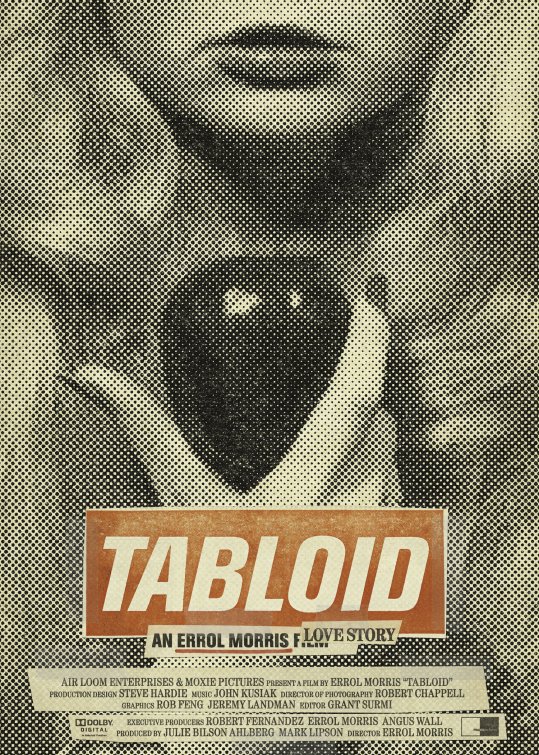
TABLOID

The new Errol Morris film Tabloid is the most lurid, off-the-wall documentary to come along in a long time. It tells the story of Wyoming PHD beauty queen, Joyce McKinney who, in the late 70's, fell in love with a flabby Mormon named Kirk Anderson. Joyce claims that his family brainwashed him into not loving her and then sent him off to London to forget about her. From there Joyce went to London, kidnapped him with chloroform and a fake gun. Drove him to a small cottage in Devon and deprogrammed him using, um... bondage sex.

From there things just get odd. After Joyce's arrest for rape and kidnapping, she becomes a media sensation meeting movie stars and rock-gods. She starts writing a book telling her story, stating that she was just an innocent girl who was trying to rescue the love of her life. She quickly enters into a rivalry with London tabloid The Daily Mirror, who disputes her "pure as the driven snow" narrative by revealing the nature of the "modeling" work she used to finance the caper, and claiming to have a plethora of nude photos as evidence.

We hear most of this story from McKinney herself. We also hear a good portion from Daily Mirror reporter Kent Gavin. McKinney claims that the stories about the time she spent in California are flat lies and that the photos are fake. Kent claims that he's seen the negatives that prove they aren't but can't produce them. Joyce also claims to have had material that would prove that they are fake. But sadly, or suspiciously, all the evidence was stolen.

It's clear that Anderson and McKinney had some sort of romantic relationship prior to all the weirdness, but it's unclear to what extent. It's unclear to what extent Anderson did or did not enjoy the "deprogramming," "You can't put a marshmellow into a parking meter," Joyce claims. It is clear that he denounced her after, perhaps out of guilt, perhaps not. The only thing that is certain is that they are not together now.

Morris weaves this tale into an extremely entertaining documentary. McKinney is a prime example of the unreliable narrator. Even if everything she said was true, she'd still come off as a self-serving obsessive at best. But Morris never demonizes her or even criticizes her, instead he sympathizes with her on a deep and real level. It's not as hard as it may seem. Joyce has not lived an easy life since the trial. For years she was hounded by paparazzi. Home videos reveal her to be extremely lonely, perhaps even clinically depressed. She never married and her only companions seem to be her dogs. It's been over 30 years since she kidnapped Kirk Anderson with the chloroform and the fake gun.  She's still working on that book.

Grade: A

Friday, December 16, 2011

THINGS I MISSED: BEGINNERS


At it's best, Beginners is a film about misfiring synapses. How our memories don't flow in a straight line, and how things get jumbled up and messy. It's also a little too humorless for it's own good. The story is essentially that of director Mike Mills. Oliver (Ewan McGregger) is a graphic designer. In the first of several timelines, Oliver's mother has just died and his father Hal (Christopher Plummer) comes out as gay. Hal start over again as a gay man at 75. A brave and difficult thing to attempt if ever there was one. His son however is a different story.

In a further off timeline Hal is dead of lung cancer and Oliver has to deal with it. He's as closed off and private as his father was when he was in the closet. Oliver doesn't do well with women and is afraid to even try. Being morose is better for the art than it is for the artist. But he finds some company in an equally distant French actress played in a charming enough performance by Melanie Laurent (Inglourious Basterds).

Their romance want's to be the backbone of the film, but it's just not as interesting as Hal's story which is positive and life affirming beyond it's LGBT dimensions. It's nice to think that a person can make such a radical life change so late in life and be successful. The film spends much time on Oliver trying to deal with Hal's coming out and death, but Oliver is too vague of a character, painted with slightly too broad of a brush to be of equal interest. His musings on life are amusing and mostly insightful, but they just don't add up to much. Laurent's character is even more problematic. She's not a real person as much as she's an archetypal abstraction of a woman. A lonely screenwriters projection.

What makes up for most of this is the style. The film floats back and forth between Oliver's various memories from four different points in his life. but it's not a mental workout figuring out where you are. The film drifts to whenever it feels it needs to-just the way that memory does. One of the films pleasures is how director Mills illustrates Olivers thoughts for us. When his father is told that he has a tumor the size of a quarter, Mills shows us a quarter against black. Then he shows us all the different combinations of coins that add up to 25 cents. It's always interesting how we think of such mundane things when we get bad news.

Hal's character aside, little of this story feels new but that's appropriate. People have been living variations of stories like this since the beginning of time and will continue to do so. Oliver likes to list what the Sun looked like in 1955 and 2003. What the stars looked like and the cars and the president. Beginners is what the mid-age, auto-biographical, emotionally adrift film looks like in 2011.

Grade: B-

Thursday, December 16, 2010

Unstoppable

Unstoppable doesn’t have memorable characters, it doesn’t have powerful performances, but it does have a rather interesting set-up and is, for the most part, a satisfactory popcorn experience.

The movie stars Denzel Washington as Frank Barnes, a railroad engineer in West Virginia on the verge of retirement and Chris Pine (Star Trek) as Will Colson, Barnes’s juiced-in greenhorn replacement. They have differences but come to respect each other. If that sounds boring and unimaginative, you’re right. But that’s not the interesting part. The interesting part is what’s happening over in Pennsylvania. There, an incompetent conductor (Ethan Suplee) has to leave a slow moving train to throw a switch on the track. While he’s away from the train cab, the throttle lever slips, and the train speeds off with nobody at the controls- — oops! We then watch as Suplee contacts yardmaster Hopper (Rosario Dawson) who tries to co-ordinate efforts to stop the train. If that doesn’t sound bad enough, the train is also full of toxic chemicals and is speeding towards Colson’s hometown.

The multiple points of view reminded me a little of the superior ‘Die Hard’ movies which also derived much of their suspense from sequences of complex logistics against impossible odds.

Of course everything that Hopper and her evil corporate overlord (Kevin Dunn) do to stop the train is a laughable failure. It’s a good thing our heroes happen to be in the neighborhood.

‘Unstoppable’ is a by-the-book, paint-by-numbers movie. It’s a formula, it’s manipulative, but it works. Denzel play’s a lower key version of his persona. Chris Pine plays off his considerable charisma and the other actors play their stock-characters effectively.

The film is unique and admirable in several ways. Its large rail yards are the real thing, no fake matte paintings. The chase scenes, featuring massive, speeding locomotives also appear to be done for real. The film features incredible stunt scenes and seemingly little CGI. Not only do the images appear authentic, but the actions do too. The actions of Hooper and co to stop the train are, of course, bad ones, but they seem more like choices made by desperate people in a tough jam then the ridiculous action movie fodder that we’re used to getting. Scott and his screenwriter Mark Bomback don’t cheat. They certainly milk the premise, but they don’t stretch logic, reason or the laws of physics.

Where the film starts to have trouble is towards the end where it becomes clear that Tony Scott is the films biggest enemy. His reliance on quick cuts, shaky cameras and fast zooms become a bit overwhelming towards the end of the film. I had a migraine by the end of the film. Even at the end, after all the action scenes had where over, the camera was still zooming around like a little kid on a sugar binge.

In spite of these problems, the film is an enjoyable diversion. You probably wont remember any of the characters or lines of dialogue. The film is about big trains going real fast. If you want to see an action movie this weekend and ‘Tron: Legacy’ doesn’t appeal to you, you’ll probably be all right with this.

Grade: C+

Sunday, October 10, 2010

The Social Network

So is it true? Is any of it true? Is none of it true? Did Mark Zuckerberg steal the idea for Facebook from a pair of Olympic rowers? Did he cheat his best friend out of his shares of Facebook? Is Mark Zuckerberg that much of an asshole?

The real life Zuckerberg says David Fincher’s new film ‘The Social Network’ is a piece of fiction. But Mark has a clear, vested interest in discrediting it. However there is further cause to doubt its source material. The film is based on a book by Ben Mezrich called ‘The Accidental Billionaires.’ Now some years ago Mezrich wrote another book based on a true story called ‘Bringing Down The House.’ The problem is that according to The Boston Globe, significant parts of that book were just plain made up. Truth fudging is accepted in film, but is kind of a no-no for books labeled ‘non-fiction.’

The story gets complicated here because ‘The Social Network’ isn’t exactly based on ‘The Accidental Billionaires.’ At the time the book was sold to Columbia Pictures it was just an outline. Screenwriter Arron Sorkin (A Few Good Men, The West Wing) used that outline as his starting point and did the majority of his own research independently. He found transcripts of Mark's former blog concerning the creation of Facemash (a website Zuckerberg wrote while in an inebriated fit over a girl) Facemash allowed users to compare the looks of female Harvard students. The initial idea was to compare the girls to farm animals, but he thought better of it. The blog transcript appears in the film almost verbatim. Looking at Sorkin’s work, I know that he is an idealistic man consumed with details, but as a storyteller his loyalty is always going to be to the story he’s trying to tell.

The Facemash incident not only gets Zuckerberg in trouble with the Harvard Admin board, it also earns him and his roommate Eduardo Saverin (Andrew Garfield) the scorn of every girl on campus. But Mark also gains the notice of the Winklevoss twins (Armie Hammer and Josh Pence) who want him to build them a social networking site. The site would mirror MySpace, but be exclusively for Harvard students. Around the same time Mark asks Eduardo to help him fund a new social networking site that uses exclusivity as its core idea. Before long Facebook is up, the Winklevoss twins are threatening legal action, and Eduardo is at the end of his wits just trying to eek out a profit for him and Mark before it all goes to Hell. To help, Mark hires Napster co-founder Sean Parker (Justin Timberlake) as a consultant. Eduardo sees Sean as a paranoid moocher and a bad influence on Mark. But Mark sees Parker as a rock-star beyond reproach, and begins to push Eduardo away, leading to more legal trouble.

The obvious comparison is to ‘Citizen Kane’ and it’s not completely undue. Both are well-crafted, controversial films told in flashbacks and based on the lives of media tycoons. But ‘Kane,’ loosely based on the life of William Randolph Hearst had the decency to change all the names (though it was obvious who it was about). Also while Charles Foster Kane was clearly based on Hearst, co-writer/director Orson Wells put just as much of himself into the character, resulting in a film that is a much more personal statement about greed, ego, etcetera. The two movies are also very different stylistically. ‘Kane’ is a grand, operatic film encompassing its subjects entire life. ‘Social Network’ is more down-to-earth and centers on Zuckerberg’s early days. The later is not a fault of the movie as Zuckerberg is only 26 and therefore has nothing but early days.

The best structural comparison would be to Akira Kurosawa’s film ‘Rashomon’ and it’s countless imitators. That film told the story of a crime from the point of view of four witnesses who all claim to be the culprit (go watch it, if you haven’t already). ‘The Social Network’ is told in flashback by Zuckerberg (Jesse Eisenberg) and various hostile witnesses called in two law suits brought against him. Kurosawa used the point of view in ‘Rashomon’ to say that memory and emotional testimonies are inherently unreliable. ‘Social Network’ does so too, but in a subtler way. We don’t see events replayed from different points of view so much, as we are made aware that the witnesses have their own agendas.

I have no clue how ‘The Social Network’ will be viewed in 20 years. I doubt that it’ll be held in the same esteem as ‘Kane’ or ‘Roshomon.’ But that said, ‘Social Network’ is a fantastically well-made film. Its complexly structured script is brimming with multi-tiered conversations and exceedingly technical details would defeat many filmmakers. Yet Fincher finds a way to make it not only watchable, but also enthralling. He boils it down to a simple core and builds on it so no matter how complicated the film gets, we always see the basic human drama going on. At the end of the day ‘The Social Network’ isn’t about coding, or theft. It’s about an awkward guy who just wants to belong and sit at the cool kids table, even if he manages to alienate the few people who might actually want to be his friends.

The film is a technical marvel as well. This is to be expected from David Fincher who, like Zuckerberg, is a tireless perfectionist (he did 99 takes of the opening scene alone). The film has a chillingly effective score by ‘Nine Inch Nails’ front man Trent Reznor and Atticus Ross. It adds a sense of playful menace to a film that is really toying with its audience. Mischievousness in story telling is a trademark of Fincher’s films (Se7en, The Game, Fight Club), but he’s more sly about it here.

Going in, I wasn’t certain if Zuckerberg stole the idea for Facebook and I’m still not. The way the film depicts him, he is certainly brilliant enough to have come up with it on his own, but he’s also arrogant enough to have stolen it. I know that a lot of the little details are true, but the answers to the big questions are really only known to Mark Zuckerberg and possibly Eduardo Saverin. The filmmakers understand this and they don’t try and give us any definitive truth. They give us truth and myth. Truth plus. A lot of movies based on fact do this, they say "based on a true story" and expect you to assume that it's all true. But Sorkin and Fincher have done something different here, by creating a film where the truth of the story we're being told is always being questioned by it's characters, they invite discussion and skepticism of the film itself. In it's own quiet way, 'Social Network' may be Fincher's most subversive film yet. This is a film that demands your attention and in exchange it gives you something to think and talk about with your friends. So you tell me, is it true?

Grade: A+